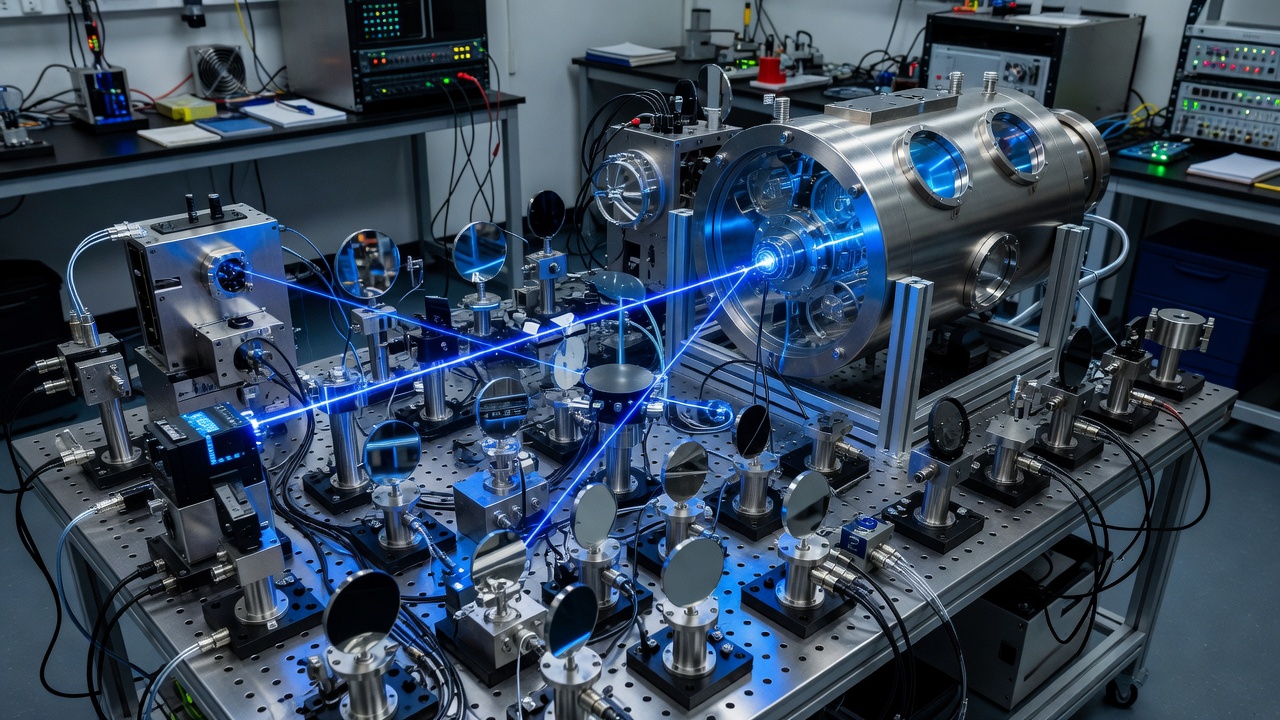
Why sensing is different
Quantum computing has to fight noise; quantum sensing feeds on it. A sensor is a system so exquisitely delicate that the tiniest change in gravity, magnetic field or time shifts its state measurably, and the same fragility that ruins a qubit's calculation is exactly what you want when the job is to notice things. That is why this corner of the field does not have to wait for millions of error-corrected qubits. Many of the devices below use a handful of atoms, or one crystal defect, or a beam of light, and they are already out of the lab.
Clocks that measure altitude
The SI second has been defined since 1967 by a microwave transition in caesium at exactly 9,192,631,770 cycles per second, and caesium fountain clocks at national laboratories realise it. The breakthrough of the last fifteen years is the optical lattice clock, which uses an optical transition in strontium or ytterbium atoms held in a grid of laser light. Because optical frequencies are tens of thousands of times higher than microwave ones, the clock ticks far more finely. Groups at JILA and NIST in Boulder, RIKEN and the University of Tokyo, PTB in Germany and NPL in the UK have all reported fractional uncertainties at the level of parts in ten to the eighteen. That is a clock that would lose less than a second over the age of the universe.
At that precision, general relativity stops being a footnote and becomes a measurement tool. Raising a clock by one centimetre changes its rate by roughly one part in ten to the eighteen, so two such clocks compared over fibre can act as an altimeter, a technique called relativistic geodesy. The international metrology bodies have been discussing a redefinition of the second based on optical clocks, with a roadmap pointing into the next decade; the current timetable is on the BIPM website.
Gravity you can map
Drop a cloud of cold atoms and use laser pulses to split, redirect and recombine their quantum wavefunctions; the interference pattern encodes how hard gravity pulled during the fall. That is an atom interferometer gravimeter, and commercial units, notably from the French firm Exail (which absorbed the earlier company Muquans), have been sold for geophysics for some years. The result that caught everyone's attention came from the University of Birmingham in 2022: a gravity gradiometer, which measures the difference in gravity between two atom clouds to cancel out vibration, detected a buried tunnel in a field test, published in Nature. That matters for utilities, archaeology and civil engineering, where finding voids without digging is worth a great deal. The trade-offs are the usual ones for cold-atom kit: size, weight, power draw and the speed of each measurement, all of which are shrinking.
Magnetometers and wearable brain scanning
Magnetometry is the oldest quantum sensing story. Superconducting quantum interference devices, SQUIDs, date to the 1960s and still sit inside the helmet-shaped magnetoencephalography scanners found in hospitals, though they need liquid helium and a rigid helmet. Optically pumped magnetometers, which read the spin of alkali atoms in a warm vapour cell, are small enough to mount on a flexible cap. A University of Nottingham team published a wearable MEG system built on them in Nature in 2018, letting a subject move their head during a scan, and the approach has since been developed commercially. Nitrogen-vacancy centres in diamond are the third route: a single defect acting as an atomic-scale magnetometer, used for imaging currents in chips and, increasingly, for inspecting batteries. None of this is a substitute for a clinician's judgement, and any medical use runs through the normal regulatory route, but the physics is mature.
Navigation without satellites
Every one of us now depends on GNSS, and every navy and airline knows how easily it can be jammed. Quantum inertial sensors, which are accelerometers and gyroscopes built from the same atom-interferometer physics as the gravimeters, promise dead reckoning that drifts far more slowly than conventional units, and a good clock on board removes another source of error. The UK government has backed flight trials of quantum navigation equipment aboard test aircraft, and several companies, including Infleqtion, have taken part. We would be cautious about any claim of imminent replacement of GNSS; the honest description is promising sensors that are still large and still being proved on moving platforms.
Squeezed light in LIGO
Our favourite example of quantum sensing at work is one most people never hear about. The LIGO gravitational-wave detectors in the United States have, since their third observing run in 2019, injected squeezed vacuum states of light into their interferometers, trading noise in one property of the light for less noise in the one that matters. In 2023 they upgraded to frequency-dependent squeezing, which improves sensitivity across the band rather than at one end. The result is more detected black-hole and neutron-star mergers per year from the same instrument. It is quantum technology quietly doing astronomy.
Reading a sensor claim. We check three things: whether a headline figure is sensitivity, accuracy or long-term stability, which are not the same; whether the device ran in a vibration-isolated laboratory or in the field; and what it weighs and draws. A lovely lab result that needs a truck is still a lab result.