Superconducting circuits
This is the platform most people picture, mainly because Google and IBM built their programmes on it and the photographs of gold-plated refrigerators are so good. The qubit is a tiny circuit, usually a design called a transmon, in which the two lowest energy levels stand in for zero and one. It only works a few hundredths of a degree above absolute zero, which is why every one of these machines lives inside a dilution refrigerator. The strengths are speed and manufacturability: gates run in tens of nanoseconds, and the chips come off lithography lines not so different from those that make ordinary electronics. Google, IBM, Rigetti and Finland's IQM all work here, and IBM announced a chip with more than a thousand qubits in 2023.
The weaknesses are equally clear. Coherence times sit in the tens to hundreds of microseconds, so everything must happen fast. Qubits only talk to their nearest neighbours on the chip, which suits the surface code and little else. And every qubit needs its own wiring down into the fridge, a bottleneck that has pushed IBM and others to talk publicly about linking several smaller chips rather than growing one enormous one.
Trapped ions
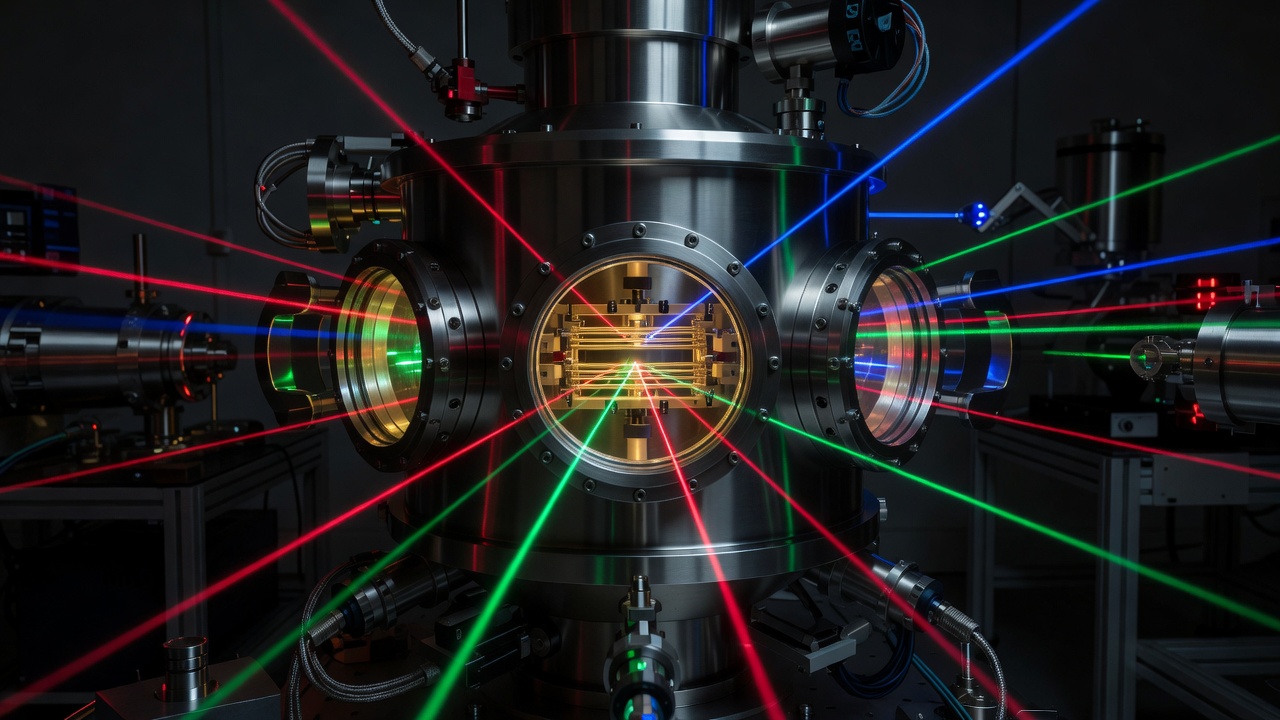
Take a single atom, remove an electron so it has a charge, and hold it in a vacuum with oscillating electric fields, a device called a Paul trap. Ytterbium-171, calcium-40 and barium are the usual choices, and lasers do the cooling, the gates and the readout. Two-qubit gate fidelities above 99.9 per cent have been demonstrated on ions, which is why Quantinuum, IonQ and Oxford Ionics keep winning on quality. Ions in the same chain can all interact with one another, which makes the connectivity effectively all-to-all and lets you run codes that would be impossible on a grid.
The price is time. Ion gates run in microseconds to milliseconds, thousands of times slower than superconducting ones, and a single chain cannot hold more than a few dozen ions before it becomes unwieldy. Scaling therefore means either shuttling ions between zones on a chip, the architecture Quantinuum calls QCCD, or linking separate traps with photons, the route IonQ has talked about. Both are demonstrated in principle and both are still hard.
Neutral atoms
Leave the atom uncharged and hold it instead with a tightly focused laser beam, an optical tweezer. Rubidium, strontium and ytterbium are the favourites. Gates come from briefly exciting atoms into giant Rydberg states, where they interact strongly with any neighbour within a few micrometres. Because the tweezers are made with programmable optics, the layout can be rearranged between and even during circuits, which is how the Harvard–MIT–QuEra team ran the 48-logical-qubit experiment described in our error-correction guide. Arrays of more than a thousand atoms were announced by Atom Computing in 2023, and university groups have since shown even larger ones. QuEra, Pasqal, Atom Computing and Infleqtion are the companies to watch.
Neutral atoms are slower than superconductors, atoms occasionally simply fall out of their tweezers and have to be replaced, and readout by camera is slow. But the combination of scale and reconfigurability has made this the platform whose roadmap changed the most in the last few years.
Photonics
Here the qubit is a particle of light, and the machine is a chip full of waveguides, beam splitters and phase shifters, in many ways just a very fancy telecom component. Photons barely notice their environment, so decoherence in flight is not the problem. The problem is the opposite: photons hardly interact with each other either, so two-qubit gates have to be built out of measurement and feed-forward, and single-photon sources fire only probabilistically. PsiQuantum, working with GlobalFoundries on silicon photonics, is betting on a scheme called fusion-based computing. Xanadu uses squeezed light and ran the programmable Borealis sampling experiment published in Nature in 2022. Quandela in France uses quantum-dot sources. Most of the chip runs at room temperature, though the superconducting nanowire detectors still need cooling, and the platform's natural affinity for fibre makes it central to our networks guide.
Silicon spin qubits
The qubit is the spin of a single electron or hole trapped in a quantum dot in silicon, and the promise is that it can be made in a CMOS foundry with a footprint of tens of nanometres. Intel, the Australian company Diraq, the UK's Quantum Motion, imec in Belgium and CEA-Leti in France all work on it. Spin qubits have been shown running at around one kelvin, far warmer than superconducting circuits, which would ease the cooling budget enormously. The catch is that each dot behaves a little differently, so variability and calibration are hard, and demonstrated qubit counts remain small. If you believe the winning platform is the one that borrows most from the chip industry, this is your bet.
Topological qubits
Microsoft's long-running programme aims to store information in Majorana zero modes at the ends of superconductor–semiconductor nanowires, where the theory says it would be protected from noise by topology rather than by error correction. In February 2025 Microsoft announced a device it calls Majorana 1 alongside a Nature paper, and the strength of the evidence for actual Majorana modes is still argued over by physicists. Caution is fair: an earlier Nature paper from a Delft group reporting a Majorana signature was retracted in 2021. If it works, the overheads discussed everywhere else on this site shrink dramatically. If it does not, it is the most expensive detour in the field.
Side by side
| Platform | The qubit is | Operating temperature | Gate speed | Connectivity | Main scaling worry |
|---|---|---|---|---|---|
| Superconducting | Circuit energy levels | Millikelvin fridge | Nanoseconds | Nearest neighbour | Wiring and chip size |
| Trapped ions | Atomic energy levels of a charged atom | Vacuum; room temp or cryogenic | Microseconds to milliseconds | All-to-all within a chain | Chain length, shuttling |
| Neutral atoms | Atom in optical tweezer | Ultra-cold atoms, room-temp apparatus | Microseconds | Reconfigurable, local | Atom loss, slow readout |
| Photonics | Photon mode | Room temp; cryogenic detectors | Speed of light; probabilistic | Set by circuit | Source efficiency, loss |
| Silicon spins | Electron or hole spin in a dot | Around one kelvin | Nanoseconds to microseconds | Nearest neighbour | Device variability |
| Topological | Majorana zero modes | Millikelvin | Not yet established | Not yet established | Existence of the modes |
Our own view, offered gently: the field is not converging, and that is fine. The next few years will be decided less by which qubit is best in isolation and more by which platform can pair with a good code, as we discuss in the error-correction guide.